Before attacking, attackers look. Everything your organization exposes on the internet makes up its external attack surface. Knowing it means knowing what to fix first.
Everything your organization exposes on the internet makes up its external attack surface, including elements that have been forgotten.
Your domains and subdomains, including forgotten ones: an old website, a test server or a provider’s tool.
Your websites and web applications.
Services reachable from the internet: email, remote access, file shares and databases.
TLS certificates and encryption settings.
DNS records, including those that protect your email.
The software versions your servers reveal.
What makes it vulnerable?
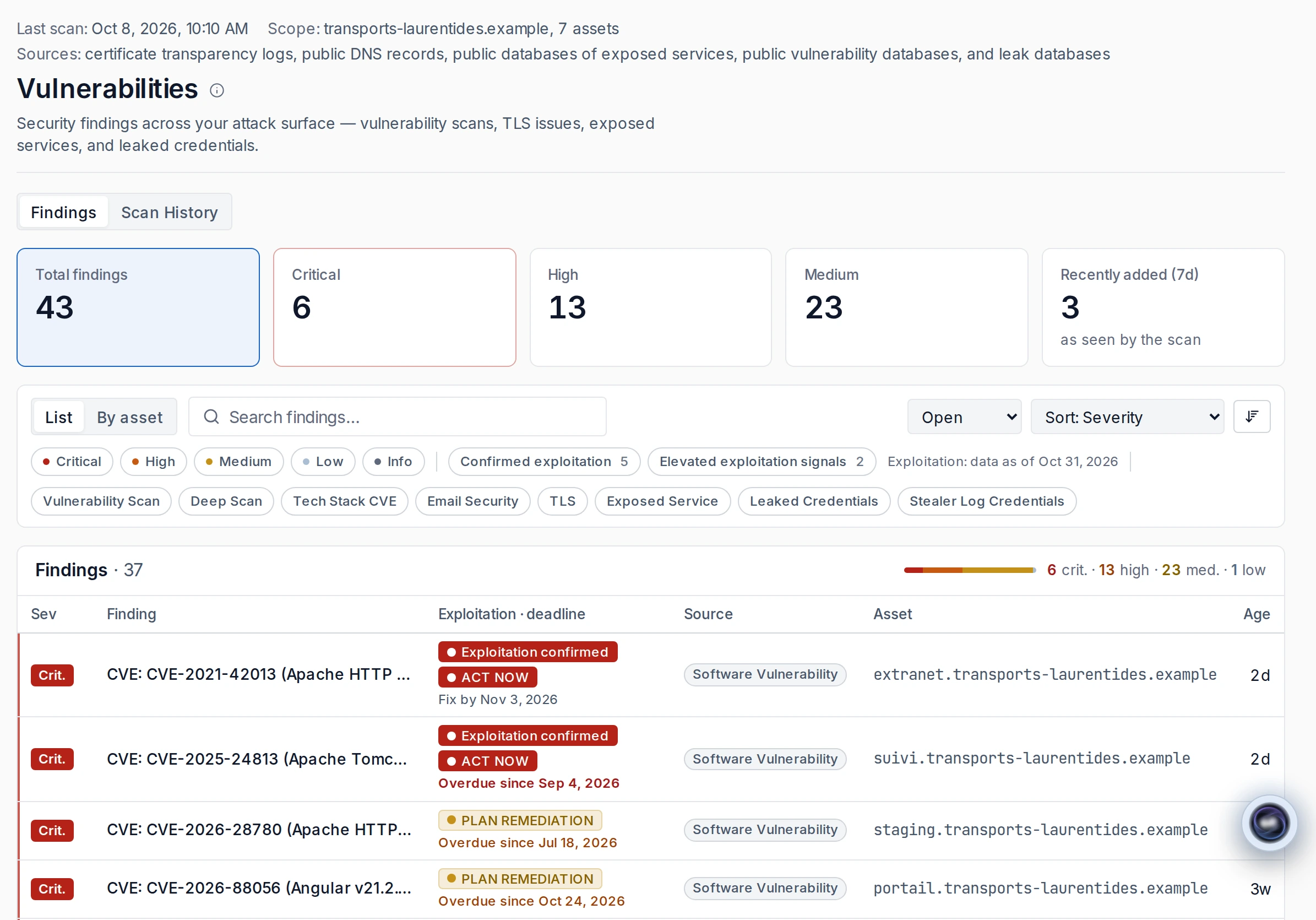
Exposed remote access, such as Remote Desktop (RDP) or an administration service, is a frequent target of brute-force attacks and a known entry point for ransomware. A version affected by a known vulnerability (Common Vulnerabilities and Exposures, or CVE) can be exploited with public tools, especially when it appears in CISA’s Known Exploited Vulnerabilities (KEV) catalogue. Expired or misconfigured certificates expose visitors to warnings and make interception easier. Without SPF, DKIM and DMARC, attackers can send emails that appear to come from your domain. An abandoned subdomain can be taken over by a third party, and a lookalike domain can be used to phish your customers or staff.
How can you reduce it?
Keep an inventory of your domains, subdomains and exposed services, and remove what is no longer used. Patch software and hardware automatically. Place remote administration behind a virtual private network (VPN) or an allowlist of addresses. Protect your email domain with SPF, DKIM and DMARC. Secure your websites by addressing the common security risks of web applications. Monitor regularly: your exposure changes with every new service, migration or change of provider.
Discover what is exposed
Predictra discovers live hosts, their services, technologies, versions, certificates and ports, with no agent to install.
What does Predictra discover?
Subdomains are found in public sources, then, for each live host: web services, technologies and versions, TLS configuration and certificates, and open ports among the 1,000 most common TCP ports. No agent is required. Discovery starts with public sources, without connecting to your servers: public certificate-transparency logs, other public subdomain sources and the directory of the breach database used by Predictra.
How are versions linked to known vulnerabilities?
Detected versions are checked against NIST’s NVD database. Each vulnerability has a remediation sheet with vendor advisories, fixed versions, exploitation probability (EPSS) and presence in CISA’s KEV catalogue.
How are false positives handled?
A user in your organization, except for the Executive role, can propose classifying a finding as a false positive. The Predictra team accepts or rejects the proposal. An accepted finding remains hidden in subsequent analyses, and its history is retained.
In the platform
Sample dataPredictra model — public sources
Email security
Predictra checks SPF (Sender Policy Framework) and DMARC (Domain-based Message Authentication, Reporting and Conformance) to identify missing protections against email spoofing.
Which records are checked?
SPF and DMARC records for your domains are checked; registered and active variants of your domain are flagged for review.
Why do these checks matter?
Without SPF, DKIM and DMARC, attackers can send emails that appear to come from your domain.
Email security
Illustration — fictitious organization
example.ca
SPFAbsent
No protection against spoofing observed.
DMARCAbsent
No email handling policy observed.
Fictitious result, not a check of this domain. The checks cover SPF and DMARC.
Go further, with your authorization
Template-based vulnerability detection and active application testing are available after proof of domain control and a signed authorization letter.
What does the free scan do?
The free scan gives a first picture, in numbers, of your external attack surface, without scanning your servers: the only connection to your website is to read its TLS certificate, like a visit.
Vulnerability detection
Template-based detection after proof of domain control and a signed authorization letter.
Read the details
Predictra can run template-based vulnerability detection after proof of domain control and a signed authorization letter.
Active application testing
Active application testing after proof of domain control and a signed authorization letter.
Read the details
Predictra can perform active application testing after proof of domain control and a signed authorization letter.
Track what changes
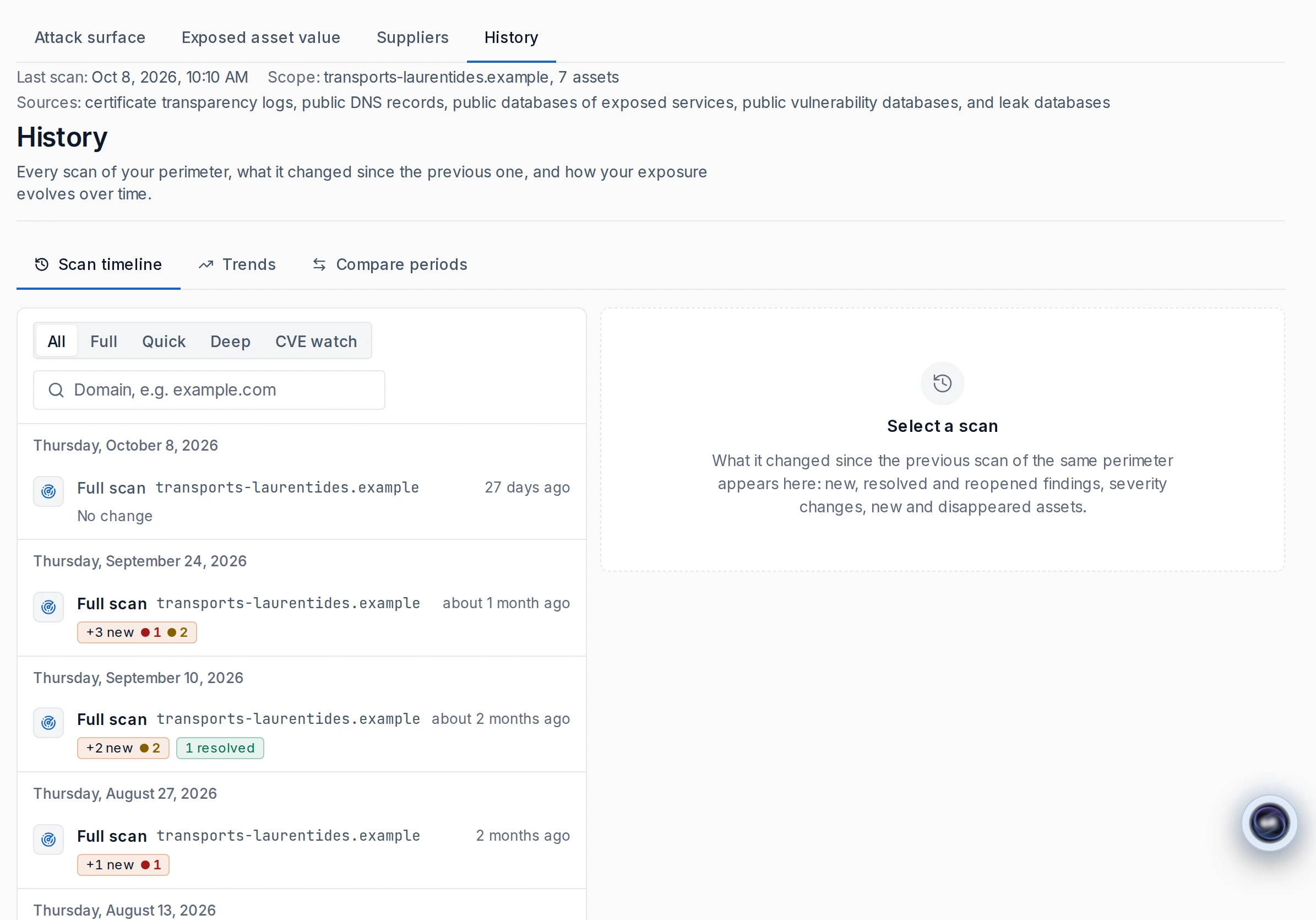
Predictra keeps the history of every analysis and the changes since the previous one, with a daily watch for new vulnerabilities on versions already detected.
What does tracking show?
Tracking shows the history of every analysis, changes since the previous one, a daily watch for new vulnerabilities on versions already detected, and the automatic closing of fixed findings.
What does the daily watch do?
It checks for new vulnerabilities on versions already detected, without running a new analysis or sending traffic to your servers.
What does the free scan provide?
The free scan gives a first picture, in numbers, of your external attack surface, without scanning your servers: the only connection to your website is to read its TLS certificate, like a visit.
In the platform
Sample dataPredictra model — public sources
Public sources
Cited public sources
Canadian Centre for Cyber Security, *Baseline cyber security controls for small and medium organizations* (BC.2.1, Automatic patching; BC.11.1, Website security). Accessed October 7, 2026. cyber.gc.ca
Canadian Centre for Cyber Security, *Implementation guidance: email domain protection* (ITSP.40.065). Accessed October 7, 2026. cyber.gc.ca